
Blog
Read what's happening in FirstouchKiosk | Keep update yourself about best digital signage solution & technology. Learn how digital signage / digital kiosk / digital notice board and digital standees can help in your business growth.
Read what's happening in FirstouchKiosk | Keep update yourself about best digital signage solution & technology. Learn how digital signage / digital kiosk / digital notice board and digital standees can help in your business growth.
 Video Wall |
  20th Aug 2026
Buying an LED video wall for a mission-critical control room is not simply an exercise in comparing pixel pitch, cabinet size, brightness, and price per square metre.
The real purchasing question is:
Will this display deliver reliable, comfortable, high-density information viewing for years without creating unnecessary maintenance costs, downtime, or operator fatigue?
That is where many B2B procurement decisions become complicated.
A low initial price can look attractive on a quotation, but the economics change when you factor in energy consumption, spare modules, service accessibility, calibration, downtime, component replacement, and technical support.
For architects, AV integrators, consultants, and enterprise buyers, the right Active LED Display should therefore be evaluated as a long-term operational system—not simply as a large screen.
Below are the nine specifications and purchasing considerations that deserve the most attention before signing the purchase order.
Pixel pitch is one of the first specifications buyers encounter when evaluating an Active LED Video Wall.
It describes the distance between individual LED pixels. A smaller pitch generally provides greater pixel density and can support detailed content at closer viewing distances.
That makes fine-pitch LED particularly relevant to control rooms where operators may need to read:
But there is a common procurement mistake:
Assuming the smallest pixel pitch is automatically the best choice.
It isn’t.
The appropriate pixel pitch depends on the actual viewing distance, content resolution, wall dimensions, and operator requirements.
A 0.9 mm solution may be unnecessary for a large wall viewed from several metres away, while a 2.5 mm solution could be inappropriate where operators sit close to the display and need to read dense information.
Ask the supplier to demonstrate the proposed pixel pitch at the actual intended viewing distance.
Don’t evaluate it only from a few centimetres away in a showroom.
The right question is:
Can the operator comfortably read the smallest critical information from the normal operating position?
That is a much better specification than simply asking for the smallest available pitch.
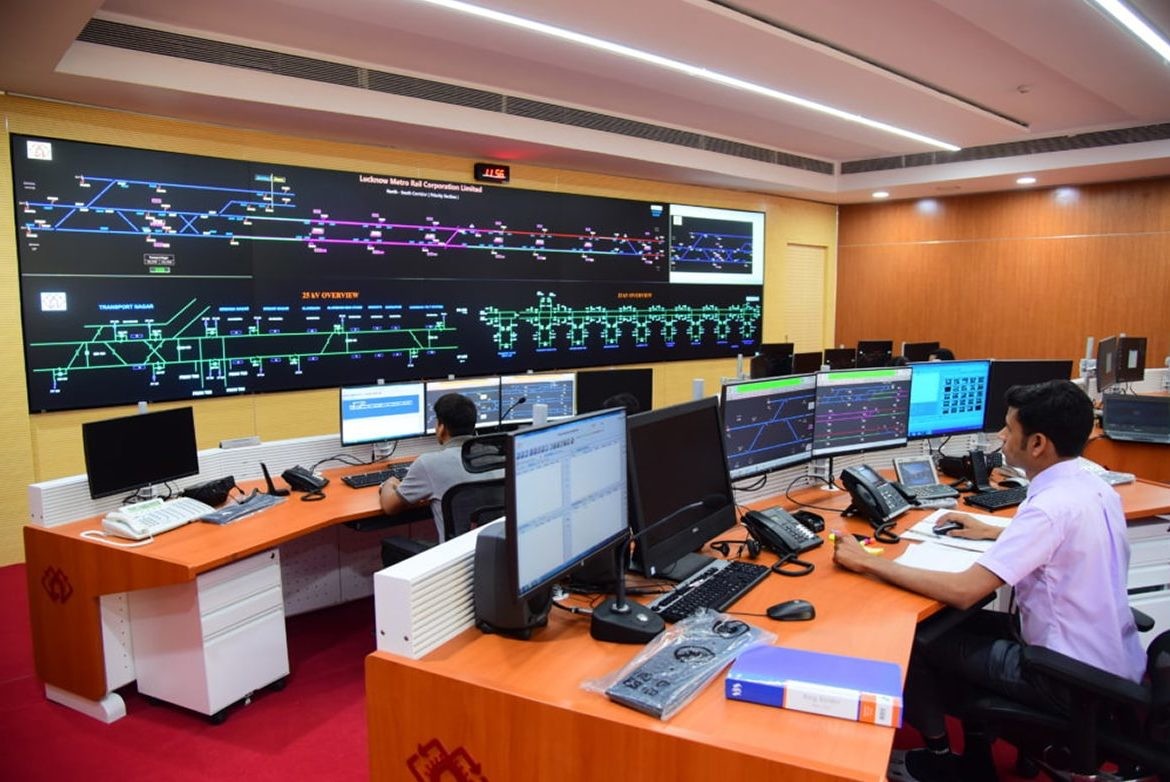
In a mission-critical control room, optical glare deserves considerably more attention than it typically receives during procurement.
Operators may spend long periods looking at the display. Reflections from windows, lighting fixtures, desks, floors, and other surfaces can interfere with comfortable viewing.
Research involving process-industry control-room operators has linked visual environmental conditions with visual fatigue and mental workload, reinforcing the importance of treating the viewing environment as part of control-room ergonomics.
A common assumption is:
More brightness = better visibility.
For an indoor control room, this can be misleading.
If ambient light is creating reflections, simply increasing display luminance may increase the brightness of those reflections as well.
A better Indoor LED Display should provide appropriate luminance control for the room rather than simply advertising the highest possible brightness.
Ask manufacturers or integrators about:
Ideally, evaluate the display in a room with lighting conditions similar to the final installation.
For control rooms, low-glare performance should be demonstrated—not merely described.
A large LED video wall is only as good as its weakest visual area.
Brightness variation between modules can become noticeable, particularly across large surfaces. Colour variation can be equally distracting when the wall is displaying maps, dashboards, CCTV, or other continuous content.
For a control room, buyers should therefore examine both:
Brightness uniformity + colour uniformity
rather than focusing solely on peak brightness.
Current Indian professional procurement specifications illustrate the level of detail buyers can encounter. Some recent command-and-control requirements have specified brightness uniformity above 97%, alongside fine pixel pitch, high refresh rate, and long rated LED lifetime.
That doesn’t mean every project needs exactly the same threshold.
It does demonstrate an important procurement principle:
Uniformity should be specified and measured, not assumed.
For a large Indoor Active LED installation, consistency over time can matter just as much as initial image quality.
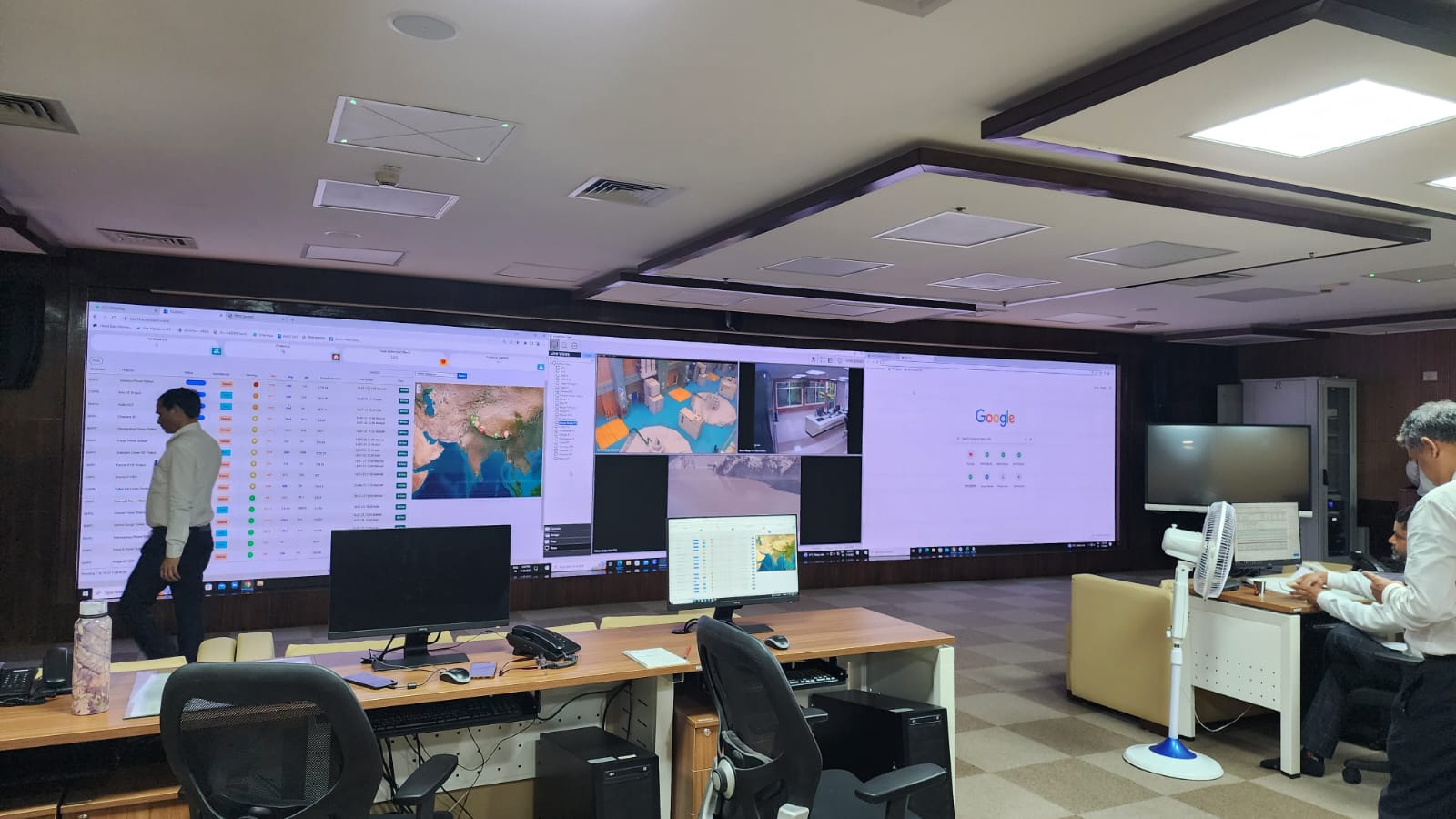
Control rooms are rarely displaying static PowerPoint slides.
They may simultaneously show:
That makes image stability important.
Professional Indian LED specifications increasingly reference refresh rates of 3840 Hz or higher for indoor professional applications.
A high refresh rate can help support smooth reproduction of dynamic content and reduce certain visual artifacts, particularly when the display is being captured by cameras.
However, buyers should not treat refresh rate as a standalone measure of overall image quality.
The source, processing chain, controller, dimming architecture, camera interaction, and content frame rate can all influence the final result.
How does the complete display system perform with our actual content?
A specification sheet is useful.
A live demonstration using your actual control-room content is better.
A control-room display may operate continuously.
That creates a completely different reliability requirement from an occasional-use corporate display or event screen.
When evaluating an Active LED Video Wall, examine the entire system:
You will frequently encounter professional LED systems specifying a rated LED lifetime of approximately 100,000 hours.
That sounds impressive—and it is useful information.
But it should not be interpreted as:
“The entire LED video wall will operate for 100,000 hours without maintenance.”
LED lifetime is only one component of system longevity.
Power supplies, electronics, connectors, controllers, receiving cards, modules, and other components have their own reliability characteristics.
The more useful procurement question is:
What happens when something fails?
That brings us to the next specification.
For a mission-critical control room, failure prevention matters.
But failure recovery matters too.
Consider two systems.
System A has an excellent theoretical failure rate but requires several days to obtain a replacement component.
System B experiences an isolated module failure but has readily available spares, front access, monitoring, and trained local support.
Which system presents lower operational risk?
The answer may not be the one with the better headline reliability figure.
Depending on project criticality, buyers may consider:
The exact architecture should reflect the operational risk of the facility.
A strong tender should address:
How quickly can the system be restored after a component failure?
That makes service-level agreements, local spare inventory, and technical support part of the display specification—not administrative details.
The most sophisticated LED video wall display can become a maintenance problem if technicians cannot reach it easily.
This is especially important when an Indoor LED Display is integrated into a finished architectural wall.
If technicians must dismantle surrounding structures to replace a module, even a small failure can become an expensive service event.
Front-serviceable systems can allow technicians to access modules from the viewing side.
Rear-serviceable systems can work well when sufficient access exists behind the display.
Neither approach is universally better.
The correct decision depends on the room architecture.
Consider:
This is one area where architectural planning can directly influence lifecycle cost.
A few centimetres of planned service access can potentially prevent much larger maintenance costs later.
CAPEX gets most of the attention during procurement.
Energy consumption often gets less.
For a 24/7 control room, that can be a mistake.
An LED video wall operating continuously consumes energy throughout its lifecycle. The impact becomes more significant as the display area increases.
When comparing systems, request both:
Do not compare only the maximum figure.
Typical consumption is more useful for estimating expected operating expenditure, while maximum consumption matters for infrastructure and electrical planning.
Heat management influences component conditions and long-term reliability.
Evaluate:
For a mission-critical installation, the LED wall should be treated as part of the building’s electrical and HVAC planning.
The final and perhaps most important specification isn’t a hardware specification at all.
It is Total Cost of Ownership.
A simple model is:
TCO = CAPEX + Energy + Maintenance + Spares + Downtime + Replacement Costs
This changes the purchasing conversation.
Instead of asking:
“Which LED wall has the lowest price per square metre?”
ask:
“Which system provides the required performance at the lowest credible lifecycle cost?”
Request:
A system that costs slightly more initially may produce better long-term economics if it offers lower energy consumption, easier serviceability, stronger local support, better redundancy, and lower downtime risk.
For a mission-critical control room, ROI can also come from:
The financial model should therefore include both cost avoidance and operational value.
Before approving an Active LED Display, ask the manufacturer or integrator to provide documented answers to these questions.
If a supplier cannot answer these questions clearly, the project may not yet be ready for purchase.
There is no universal winner.
An Active LED Video Wall can provide a seamless large-format canvas, flexible dimensions, and fine-pitch options that are particularly attractive for high-density visualization.
LCD video walls can remain highly effective for certain control-room applications, particularly where viewing distance, panel resolution, budget, and maintenance strategy favour that architecture.
The right choice depends on:
| Decision Factor | Indoor Active LED | LCD Video Wall |
|---|---|---|
| Seamless surface | Strong advantage | Visible bezels |
| Large-format flexibility | High | Panel-based |
| Fine-pitch options | Wide range | Panel dependent |
| Close viewing | Pixel-pitch dependent | Panel dependent |
| Brightness control | Important | Important |
| Maintenance | Module/system dependent | Panel dependent |
| 24/7 capability | Configuration dependent | Configuration dependent |
| TCO | Project specific | Project specific |
The mistake is not choosing LED or LCD.
The mistake is choosing either technology without modelling the operational requirements first.
A successful control-room display project starts before the LED manufacturer is selected.
Architects should establish:
AV integrators should establish:
This creates a project where the display technology supports the room, rather than forcing the room to accommodate a display that was selected too late.
The best LED video wall is the one that matches the control room’s viewing distance, content density, lighting conditions, reliability requirements, service model, and lifecycle budget. Fine-pitch Indoor Active LED is often worth evaluating for high-density mission-critical visualization, but specifications should be validated against the actual environment.
Choose pixel pitch based on the closest and typical operator viewing distance and the smallest information that operators must read. Smaller is not automatically better; the objective is sufficient information density without paying unnecessarily for pixel density the room does not require.
Low-glare design can help reduce distracting reflections and improve viewing comfort, but visual fatigue depends on the entire environment—including lighting, viewing distance, display luminance, content, workstation ergonomics, and operator behaviour. Low glare should therefore be treated as one part of an overall ergonomic design strategy.
A 3840 Hz refresh rate is a common professional specification and can support stable reproduction of dynamic content, but refresh rate alone does not determine image quality. The complete source, processor, controller, dimming architecture, and display system should be evaluated together.
Professional systems can specify LED lifetimes around 100,000 hours, but this should not be interpreted as a maintenance-free system lifespan. Actual lifecycle depends on operating conditions, component quality, thermal management, calibration, maintenance, and replacement strategy.
Neither should be considered in isolation. Pixel pitch affects detail and viewing distance, while brightness affects visibility and viewing comfort. For an indoor control room, the correct balance is more important than maximizing either specification.
Start with total cost of ownership: purchase and installation costs, energy, maintenance, spares, downtime, replacement costs, and expected lifecycle. Then consider operational benefits such as information visibility, reliability, maintainability, and reduced disruption.
Choosing the right LED video wall is a long-term decision involving technology, architecture, operator experience, reliability, and ROI.
Firstouch works with businesses, architects, consultants, and AV integrators to evaluate mission-critical display requirements and develop solutions around the project’s actual operational needs.
If you’re:
A mission-critical control room deserves more than a high-resolution display.
It needs a visualization system that operators can use comfortably for extended periods, that engineers can maintain efficiently, and that procurement teams can justify financially.
That’s why the most important specifications are not simply the ones printed in the largest font on a product brochure.
Pixel pitch matters. Glare matters. Brightness matters. Refresh rate matters.
But so do redundancy, serviceability, thermal management, power consumption, technical support, and total cost of ownership.
For B2B buyers, architects, consultants, and AV integrators, the smartest approach is to evaluate an Active LED Display as mission-critical infrastructure.
Because the real ROI isn’t achieved when the LED wall is installed.
It’s achieved when that LED wall continues delivering clear, reliable, efficient performance year after year.
BACK TO BLOG
we are always happy to help in ways that we can.


