
Blog
Read what's happening in FirstouchKiosk | Keep update yourself about best digital signage solution & technology. Learn how digital signage / digital kiosk / digital notice board and digital standees can help in your business growth.
Read what's happening in FirstouchKiosk | Keep update yourself about best digital signage solution & technology. Learn how digital signage / digital kiosk / digital notice board and digital standees can help in your business growth.
 Touch Screen Kiosk |
 27th Oct 2026
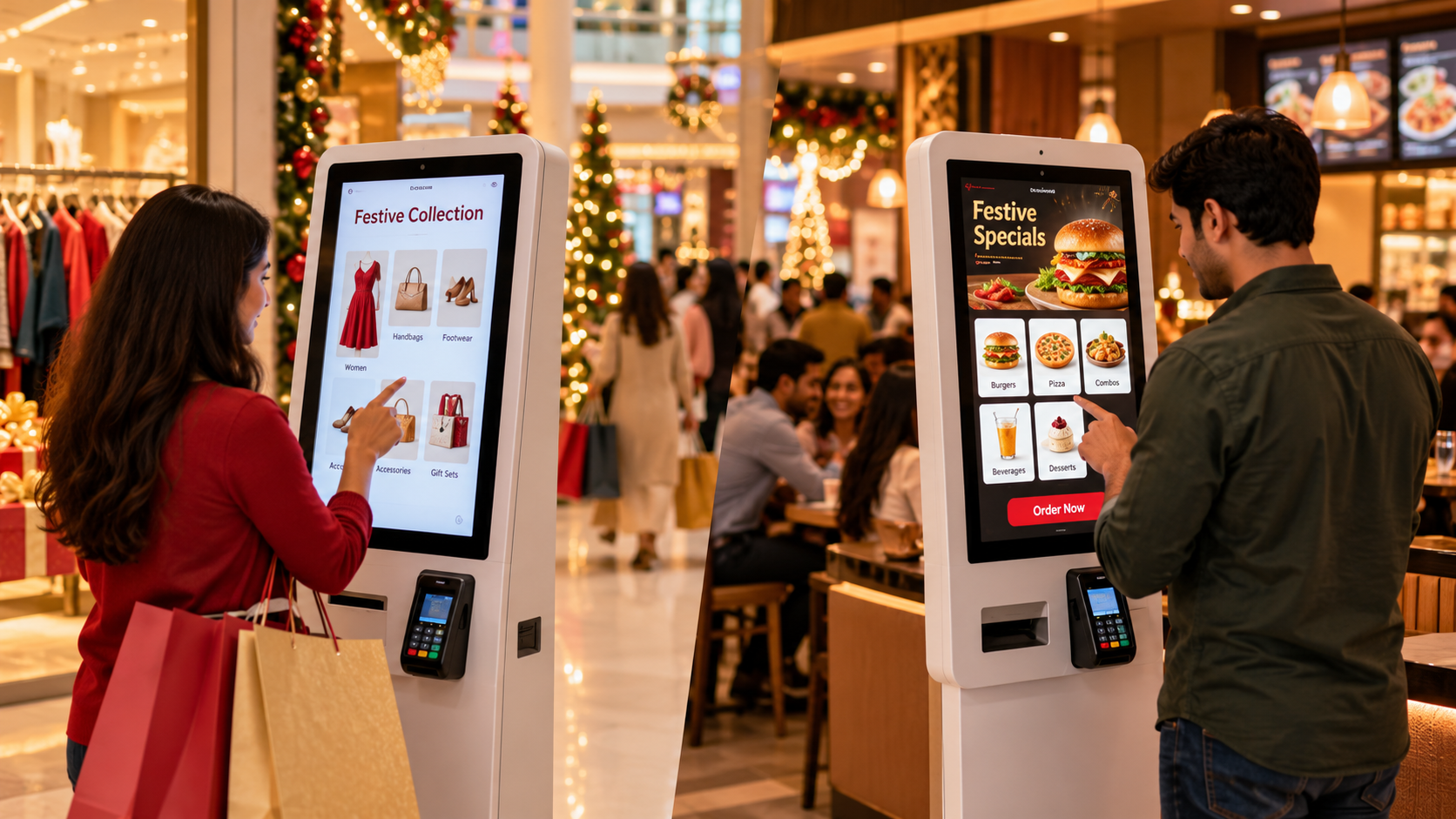
The festive season brings some of the biggest opportunities of the year for retailers and restaurants. From Diwali shopping and holiday promotions to family dining and special celebrations, customers are ready to explore new products, discover exciting offers, and spend on experiences that make the season memorable.
But increased demand comes with a challenge. Long queues, crowded counters, delayed orders, and overwhelmed employees can quickly affect customer satisfaction. When shoppers have to wait too long or diners struggle to place an order, businesses risk losing sales to competitors offering a faster, more convenient experience.
This is where self-service kiosks can make a difference.
By allowing customers to browse, select, customize, and order independently, self-service kiosks help businesses manage busy periods while delivering a more convenient customer journey. For retailers and restaurants preparing for the festive rush, the right kiosk solution can support smoother operations, better promotion visibility, and more efficient service.
During peak shopping and dining periods, customers expect more than attractive prices and festive offers. They want quick service, easy transactions, clear information, and a hassle-free experience.
Retail stores must handle increased footfall while helping shoppers find products and complete purchases. Restaurants need to manage incoming orders without creating bottlenecks at the ordering counter. Meanwhile, employees must balance customer assistance with inventory management, order fulfillment, and daily operational responsibilities.
Traditional service processes can struggle when several customers need assistance simultaneously.
Self-service kiosks introduce an additional way to serve customers. Instead of relying exclusively on an employee for every routine transaction, businesses can let customers complete supported tasks through an interactive digital interface.
This creates a more flexible service environment in which technology handles routine interactions and employees remain available for situations that require personal attention.
Few things frustrate festive shoppers and restaurant customers more than standing in a long queue.
Self-service kiosks can help distribute customer demand by providing additional ordering or transaction points. In quick-service restaurants, customers can browse the menu and submit orders independently. In retail environments, suitable kiosks can help shoppers access product information or complete supported self-service tasks.
This additional capacity can ease pressure on traditional counters and make the overall service experience more manageable.
For businesses, the advantage is not simply having another screen on the premises. It is creating a more efficient customer journey when demand is highest.
Festive customers often have specific needs. Some shoppers want to compare products before making a purchase, while others are searching for gifts, special offers, or complementary items. Restaurant customers may want to customize meals or explore seasonal menu options.
Self-service kiosks allow customers to navigate available choices at their own pace.
Interactive menus, clear product descriptions, and straightforward ordering steps can help customers make decisions with greater confidence. Depending on the configuration, businesses may also provide multilingual interfaces and convenient digital payment options.
This flexibility is particularly valuable when stores and restaurants are busy, because customers can explore their options without waiting for an employee to explain every detail.
Festive campaigns often include gift bundles, seasonal collections, limited-period discounts, and special meal combinations. However, promotions only create value when customers notice them and understand their benefits.
Self-service kiosks can bring selected offers directly into the customer journey.
A restaurant could feature a festive meal combination or suggest an additional beverage. A retailer could showcase complementary accessories, gift sets, or seasonal products alongside a customer’s selection.
When these recommendations are relevant and clearly displayed, they can encourage customers to consider additional purchases and may increase average transaction value.
The key is to make every suggestion useful. Too many promotional messages can complicate the experience, so businesses should prioritize offers that genuinely match customer interests.
The festive rush can leave employees managing multiple responsibilities at once. Processing routine transactions while answering questions, organizing products, and coordinating orders can put considerable pressure on frontline teams.
Self-service kiosks can take over selected routine interactions, allowing employees to concentrate on activities that benefit from human involvement.
Restaurant employees can focus on food preparation, order accuracy, and customer assistance. Retail staff can spend more time helping shoppers compare products, find the right sizes, and make informed purchasing decisions.
This combination of self-service and personal support helps businesses serve customers more flexibly without removing the human element from the experience.
When customer volumes rise, businesses need processes that remain clear and dependable.
A properly configured kiosk can present products, prices, available options, and promotional information through a standardized interface. When integrated with compatible point-of-sale and business systems, it can also help reduce manual order-entry errors and streamline transaction processing.
However, successful implementation requires more than installing hardware. Businesses should test their software integrations, payment systems, network connectivity, and transaction workflows before peak demand begins.
Reliable equipment, regular maintenance, and a clear backup process help ensure that technology supports the customer experience instead of disrupting it.
Although the underlying technology is similar, its value depends on how each business uses it.
Retailers can use suitable self-service kiosk solutions to help customers explore products, access promotional information, and complete supported transactions. Depending on the system, kiosks may also support product discovery and self-checkout workflows.
During festive sales, these applications can help manage routine customer requests and make important information easier to access.
Ordering kiosks allow customers to browse menus, customize meals, choose add-ons, and submit orders through an interactive interface.
This can help distribute demand at the ordering counter during busy lunch periods, evenings, and festive gatherings. Integrations with compatible POS and kitchen systems can further support order processing.
High-footfall environments often experience several customer bottlenecks at the same time. Depending on their configuration, kiosks can support ordering, information access, or self-checkout processes.
The most effective application is one that addresses a clearly identified operational challenge rather than adding technology without a defined purpose.
The right kiosk should fit the business’s actual requirements, not simply look impressive on the shop floor.
Before making a decision, retailers and restaurant operators should consider:
Planning these details before the festive rush helps businesses select a practical solution that supports both immediate requirements and future growth.
For businesses preparing for a high-demand season, choosing the right technology partner is an important part of the implementation process.
Firstouch offers self-service kiosk solutions for commercial applications, including retail and quick-service restaurant environments. Depending on the selected configuration, kiosk systems can incorporate touchscreen technology and peripherals such as QR or NFC scanners and receipt printers.
Retailers and restaurant operators should begin by identifying the service challenges they want to address, whether that means simplifying order placement, supporting customer self-service, or improving access to product information.
With these requirements clearly defined, businesses can evaluate suitable kiosk configurations and determine how the technology can fit into their existing operations.
To explore available options, visit Firstouch Interactive Solution
Self-service kiosks allow customers to complete supported transactions independently, helping businesses distribute customer demand, reduce reliance on staffed counters for routine tasks, and present relevant festive promotions.
They can help reduce bottlenecks at the ordering counter by allowing customers to place orders independently. Overall service speed also depends on payment processing, kitchen capacity, order preparation, and kiosk adoption.
Kiosks can showcase seasonal products, complementary items, and special offers. These features may encourage additional purchases when promotions are relevant and the purchasing process remains convenient.
They can be suitable when the expected usage and operational benefits justify the investment. Businesses should evaluate customer volume, available space, implementation costs, and compatibility with existing systems before choosing a solution.
Important considerations include touchscreen usability, compatible software, payment options, required peripherals, security, accessibility, maintenance, and integration with existing business systems.
Businesses should test all transaction workflows, update seasonal promotions, verify payment and POS integrations, train employees, schedule maintenance, and establish a backup service process before peak demand begins.
The festive season offers retailers and restaurants an opportunity to attract new customers, strengthen customer relationships, and increase sales. However, delivering a positive experience during peak demand requires more than attractive offers. Businesses must also make purchasing and ordering as convenient as possible.
Self-service kiosks can help address this challenge by supporting faster transactions, improving access to product information, showcasing relevant promotions, and allowing employees to focus on customer needs.
The real advantage comes from choosing the right kiosk for the business, integrating it properly, and ensuring that customers can use it with
BACK TO BLOG
we are always happy to help in ways that we can.


